
Horizontal vs Vertical Laminar Flow Cabinets
Horizontal vs Vertical Laminar Flow Cabinets: What’s the Difference?
Laminar flow cabinets help create clean working environments by reducing airborne contamination. Laboratories, electronics manufacturers and precision assembly businesses use these cabinets to protect sensitive products from dust and unwanted particles.
Two common options are Horizontal Laminar Flow (HLF) and Vertical Laminar Flow (VLF) cabinets.
Both systems use high-efficiency filters to supply clean air. However, they direct the airflow in different ways. As a result, each type offers specific advantages for different tasks.
In this guide, we explain how both systems work. We also compare their benefits, limitations and common uses to help you choose the right cabinet.
What Is a Laminar Flow Cabinet?
A laminar flow cabinet, also known as a clean bench or clean air workstation, protects sensitive products from airborne contamination.
The cabinet draws air through a High-Efficiency Particulate Air (HEPA) filter or another suitable high-efficiency filter. It then directs clean air across the workspace in a steady, controlled stream.
This airflow helps prevent dust and other particles from settling on sensitive materials.
Laminar flow cabinets support many applications, including:
- Electronics and precision component assembly
- Optical equipment manufacturing
- Laboratory work involving non-hazardous materials
- Clean assembly and inspection processes
- Certain controlled pharmaceutical applications
- Other processes requiring clean air
Unlike standard fume extraction systems, laminar flow clean benches mainly protect the product rather than the operator.
Therefore, choosing the correct equipment is especially important when handling hazardous substances.
Horizontal vs Vertical Laminar Flow: The Main Difference
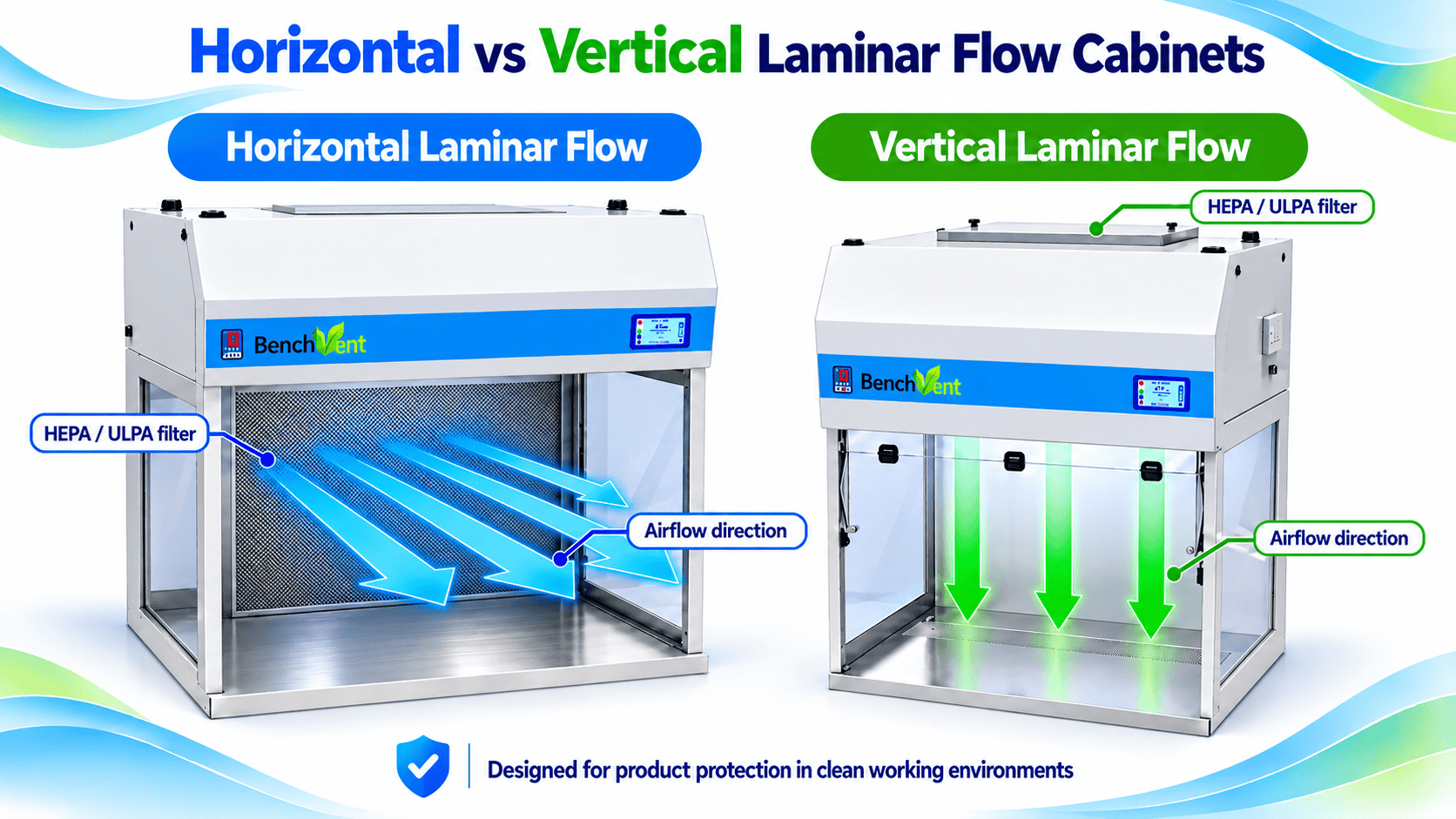
The main difference between horizontal and vertical laminar flow cabinets is the direction of airflow across the workspace.
Horizontal cabinets direct clean air from the back of the unit towards the operator.
In contrast, vertical cabinets direct clean air from above towards the work surface.
Both systems help reduce airborne contamination. However, the airflow direction affects equipment placement, working methods and suitability for different tasks.
How Does a Horizontal Laminar Flow Cabinet Work?
A horizontal laminar flow cabinet usually has its main filter at the rear of the working chamber.
The system pushes clean air through the filter and across the work surface. The air then flows out through the front opening towards the operator.
As a result, sensitive components receive a steady stream of clean air.
Advantages of horizontal laminar flow cabinets
- Provide a direct flow of clean air across the workspace.
- Offer effective product protection when operators position materials correctly.
- Allow good visibility and access to the working area.
- Support delicate assembly and inspection tasks.
- Help reduce airborne contamination around sensitive components.
Potential limitations
Horizontal airflow travels towards the operator. Therefore, these cabinets are unsuitable for processes that release hazardous airborne substances.
Objects and hands can also block the airflow. For example, a large component may prevent clean air from reaching a smaller item behind it.
For this reason, operators should arrange materials carefully to maintain a steady airflow.
How Does a Vertical Laminar Flow Cabinet Work?
A vertical laminar flow cabinet usually has its main filter above the working area.
The system directs clean air downwards towards the work surface. Depending on the cabinet design, air may leave through the front opening, other outlets or return grilles.
This downward airflow helps prevent airborne particles from entering the clean working area.
Advantages of vertical laminar flow cabinets
- Provide a steady downward flow of clean air.
- Support processes that benefit from overhead airflow.
- Offer different workspace arrangements from horizontal models.
- May reduce the direct flow of air towards the operator’s face.
- Suit selected clean laboratory and precision manufacturing tasks.
Potential limitations
Tall equipment can block downward airflow and create turbulence.
Similarly, operators may introduce particles when placing their hands or tools above sensitive materials.
Therefore, careful working methods remain essential.
Importantly, downward airflow does not automatically protect the operator from hazardous substances.
Horizontal vs Vertical Laminar Flow Cabinets: Comparison
The table below highlights the main differences between the two cabinet types.
| Feature | Horizontal Laminar Flow | Vertical Laminar Flow |
|---|---|---|
| Airflow direction | Back to front | Top to bottom |
| Main filter location | Rear of cabinet | Top of cabinet |
| Main purpose | Product protection | Product protection |
| Operator protection | No, for standard clean benches | No, for standard clean benches |
| Airflow around objects | Objects may block airflow from behind | Tall objects may disrupt downward airflow |
| Workspace access | Often open at the front | Varies by design |
| Common applications | Electronics, optics and clean assembly | Clean laboratory work and precision assembly |
| Hazardous substances | Not suitable | Not suitable without specialist containment |
Both systems can deliver effective contamination control with proper use and maintenance.
However, neither option is automatically better. The ideal choice depends on your work, materials and workspace.
Which Laminar Flow Cabinet Offers Better Contamination Control?
Both horizontal and vertical laminar flow cabinets help reduce airborne contamination.
However, their performance depends on how operators arrange and use the workspace.
Product Protection
Horizontal airflow works particularly well when clean air travels directly over sensitive components.
Because the air moves from the rear towards the front, it helps carry unwanted particles away from the clean air supply.
However, large objects can block airflow to materials further forward.
Vertical airflow takes a different approach.
Clean air travels downwards over the workspace. This arrangement can suit tasks that benefit from overhead filtration.
Nevertheless, hands, tools and tall equipment can disrupt airflow and affect product protection.
For the best results, operators should keep the airflow as clear and steady as possible.
Reducing Cross-Contamination
Cross-contamination happens when unwanted particles move between products, materials or working areas.
Both cabinet types help reduce this risk when operators follow good working practices.
For example, operators should:
- Keep the working area clean and tidy.
- Avoid unnecessary movement inside the cabinet.
- Position materials away from airflow obstructions.
- Clean work surfaces regularly.
- Follow the manufacturer’s instructions.
- Arrange suitable filter maintenance and performance checks.
In addition, staff should understand how their movements affect airflow inside the cabinet.
Good working practices are just as important as choosing the correct equipment.
What Are Horizontal Laminar Flow Cabinets Used For?
Many industries use horizontal laminar flow cabinets to protect sensitive products from airborne particles.
These cabinets are particularly useful for clean assembly, inspection and handling tasks.
Electronics Manufacturing
Dust and airborne particles can affect sensitive electronic components.
Therefore, electronics manufacturers often need clean working conditions for certain assembly and inspection tasks.
Horizontal laminar flow cabinets help provide these conditions by supplying a steady stream of clean air.
For example, they can support the assembly of non-hazardous precision components where dust control is essential.
Optical Equipment
Lenses, optical sensors and precision instruments require careful handling.
Even small dust particles can affect assembly work or the quality of finished products.
As a result, horizontal laminar flow cabinets can help protect these components during suitable clean assembly tasks.
Precision Assembly
Many manufacturing processes need clean working areas to maintain product quality.
Horizontal laminar flow cabinets support these tasks by reducing airborne particles around sensitive materials.
However, some processes also produce chemical vapours, fumes or hazardous dust.
In these cases, operators need suitable extraction or containment equipment instead of a standard clean bench.
What Are Vertical Laminar Flow Cabinets Used For?
Vertical laminar flow cabinets support clean laboratory and manufacturing processes.
Their downward airflow makes them useful for tasks that benefit from overhead filtration.
Laboratory Preparation
Vertical laminar flow cabinets can provide clean working conditions for selected non-hazardous laboratory procedures.
For example, they may help protect sensitive materials from unwanted airborne particles.
However, standard clean benches cannot safely contain infectious materials.
Laboratories handling biological hazards must use equipment that provides the correct level of biological protection.
Pharmaceutical Applications
Certain pharmaceutical processes require clean, controlled working areas.
Specialist vertical laminar flow systems can support selected non-hazardous sterile processes.
However, pharmaceutical preparation involves strict safety and quality requirements.
Therefore, operators must confirm that the equipment meets the relevant standards before use.
A standard vertical laminar flow cabinet is not automatically suitable for sterile pharmaceutical preparation.
Precision Manufacturing
Vertical airflow also supports clean assembly and inspection work.
The downward stream of clean air helps protect sensitive components from airborne particles.
However, operators must consider the size and position of their equipment.
Tall objects can disrupt airflow and reduce the system’s effectiveness.
Are Laminar Flow Cabinets the Same as Fume Extraction Units?
No. Although the equipment may look similar, laminar flow cabinets and fume extraction units perform different jobs.
A standard laminar flow cabinet supplies filtered air to protect sensitive products from dust and airborne contamination.
In contrast, a fume extraction unit captures and controls substances that a process releases into the air.
Depending on the system, these may include fumes, vapours, dust and other airborne contaminants.
For example, a laminar flow cabinet may suit the clean assembly of delicate electronic components.
However, soldering, solvent cleaning and coating processes can release substances that require dedicated extraction.
Therefore, operators should not use a standard laminar flow clean bench as a replacement for suitable fume extraction equipment.
The Health and Safety Executive provides guidance on controlling exposure to hazardous substances. This includes information about local exhaust ventilation and other safety measures.
Do Laminar Flow Cabinets Protect the Operator?
Standard horizontal and vertical laminar flow clean benches mainly provide product protection, not operator protection.
Their airflow can carry harmful substances towards the operator or into the surrounding room.
Therefore, standard clean benches are unsuitable for hazardous fumes, toxic powders, infectious materials or other substances that require containment.
If a process involves these hazards, a different system may be necessary.
For example:
- Microbiological safety cabinets provide biological protection when the cabinet class and design suit the task.
- Fume cupboards help control exposure to suitable hazardous chemical vapours and gases.
- Dust extraction systems help capture harmful airborne dust at its source.
- Specialist extraction cabinets support other industrial processes that generate hazardous substances.
The correct equipment depends on the material, process and level of protection required.
What Should You Consider Before Buying a Laminar Flow Cabinet?
Choosing between horizontal and vertical laminar flow involves more than airflow direction.
Before buying a cabinet, consider the following factors.
1. Your Application
First, decide what you need to protect.
If airborne dust could damage sensitive products, a laminar flow cabinet may provide a suitable solution.
However, if your process creates hazardous fumes, vapours or dust, you may need dedicated extraction equipment instead.
2. Workspace Dimensions
Consider the size of your equipment and the available working space.
Horizontal cabinets need enough room for clean air to travel across the work surface.
Meanwhile, vertical cabinets need enough clearance between the overhead filter and the equipment below.
Large or tall objects can disrupt airflow in either design.
Therefore, always check the internal working dimensions before choosing a cabinet.
3. Filtration Requirements
Most laminar flow cabinets use HEPA filters or other high-efficiency filters to remove airborne particles.
However, filter specifications can vary between models.
For example, some specialist cabinets use ULPA filters for a higher level of particle removal.
Before choosing a unit, check its filter class, clean air performance and suitability for your application.
Also, consider the cost and ease of filter replacement.
4. Installation Environment
The surrounding environment can affect cabinet performance.
Air conditioning, open doors, ventilation systems and nearby movement may disturb the airflow.
Therefore, choose a location away from strong draughts and busy walkways.
In addition, follow the manufacturer’s installation guidance to achieve the best results.
5. Maintenance and Testing
Regular maintenance helps keep a laminar flow cabinet working correctly.
Depending on the cabinet and its application, maintenance may include:
- Cleaning the work surface and chamber.
- Checking the filtration system.
- Monitoring airflow performance.
- Inspecting seals and other parts.
- Replacing filters when necessary.
- Arranging suitable performance tests.
In addition, operators should follow the manufacturer’s recommended maintenance schedule.
A well-maintained cabinet helps provide reliable contamination control over time.
Frequently Asked Questions
Is horizontal or vertical laminar flow better?
Neither system is automatically better.
Horizontal airflow often suits clean assembly and precision handling tasks.
In contrast, vertical airflow may work better where overhead filtration suits the workspace.
The best option depends on your application, materials and cleanliness needs.
Do both systems use HEPA filters?
Both horizontal and vertical laminar flow cabinets typically use HEPA or other high-efficiency filters.
These filters remove airborne particles before clean air enters the workspace.
However, the filter type and performance level vary between models.
Can a vertical laminar flow cabinet handle hazardous powders?
A standard vertical laminar flow clean bench cannot safely contain hazardous powders.
Instead, operators need equipment that controls exposure and prevents harmful dust from escaping into the workplace.
Are laminar flow cabinets suitable for soldering?
Standard laminar flow clean benches do not protect operators from soldering fumes.
Therefore, soldering work may require suitable local exhaust ventilation or dedicated fume extraction equipment.
Do laminar flow cabinets remove chemical fumes?
HEPA filters capture airborne particles. However, they do not effectively remove chemical vapours or gases.
If your work produces solvent vapours or other harmful gases, you need a suitable system that controls those substances.
Can laminar flow cabinets support sterile work?
Yes, certain specialist systems can support non-hazardous sterile processes.
However, the equipment must meet the relevant safety and quality requirements.
A standard clean bench is not automatically suitable for pharmaceutical sterile preparation or biological containment.
Conclusion: Which Laminar Flow Cabinet Should You Choose?
Both horizontal and vertical laminar flow cabinets help protect sensitive products from airborne contamination.
Horizontal laminar flow cabinets direct clean air from the rear of the cabinet towards the operator. As a result, they often suit electronics, optics and other clean assembly tasks.
Vertical laminar flow cabinets direct clean air downwards towards the work surface. Therefore, they can suit selected laboratory processes and precision manufacturing tasks.
However, the right choice depends on your working environment, equipment and materials.
Most importantly, standard laminar flow clean benches do not protect operators from hazardous substances.
If your process generates harmful fumes, vapours or dust, you may need suitable extraction or containment equipment instead.
Need Help Choosing the Right Cabinet?
At BenchVent, we understand the importance of choosing the correct equipment for your workplace.
Whether you need a clean air workstation, laminar flow cabinet or dedicated fume extraction system, the right solution can help you create a safer and more effective working environment.
Explore our range of laminar flow cabinets and extraction equipment, or contact BenchVent to discuss your requirements.